
Introduction
Multiple pregnancies account for approximately 1–3% of all pregnancies worldwide, with twin pregnancies representing 98% of these cases. However, the incidence of twin pregnancies varies across different geographical regions. The highest incidence is observed in sub-Saharan Africa (1.8%), while the lowest is reported in East and Southeast Asia (0.6%). Intermediate rates are observed in Europe, North America, and South Asia.
Although the overall incidence of twin pregnancies varies geographically, the incidence of monozygotic twinning remains relatively constant, with a slight increase associated with assisted reproductive technologies (ART), particularly when embryo transfer involves blastocysts that have undergone micromanipulation during fertilization.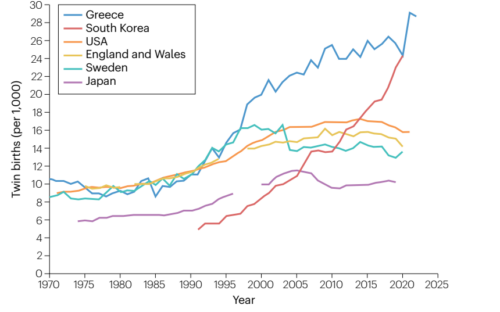
Since 2000, Greece has experienced a remarkable increase in twin pregnancies compared with other developed countries, primarily due to the widespread use of assisted reproductive technologies. This trend warrants careful consideration by the relevant regulatory authorities.
How Does a Twin Pregnancy Occur?
Twin pregnancies arise either from the fertilization of two separate oocytes, resulting in two zygotes and two genetically distinct embryos, each developing within its own amniotic sac and with a separate placenta (dichorionic diamniotic dizygotic twin pregnancy), or from the fertilization of a single oocyte, resulting in one zygote that subsequently divides to produce twins.
In the latter case, different types of twin pregnancies may develop depending on the timing of embryonic division, with the traditional defining characteristic being the presence of essentially identical genetic material (monozygotic twin pregnancy).
According to the classical embryological model, if division occurs very early, during the zygotic stage and up to the third day after fertilization, the resulting pregnancy consists of two separate amniotic sacs and two separate placentas (dichorionic diamniotic monozygotic twin pregnancy).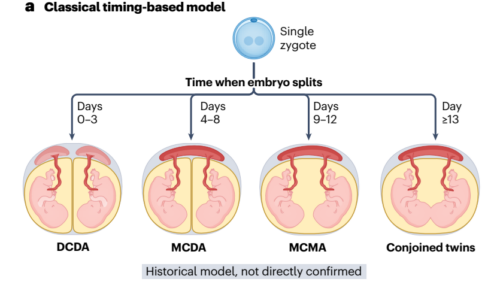
Figure: Embryonic development and the resulting type of twin pregnancy according to the timing of embryonic division.
However, division most commonly occurs between days 3 and 8, particularly during the early blastocyst stage (approximately day 5). In this case, the pregnancy consists of two amniotic sacs sharing a single placenta (monochorionic diamniotic twin pregnancy).
When division occurs after day 8, the twins share both a single amniotic sac and a single placenta (monochorionic monoamniotic twin pregnancy).
If division occurs after day 12 and remains incomplete, conjoined twins may develop, with the fetuses physically connected at various anatomical regions.
Chorionicity is the most important clinical determinant of the outcome of a twin pregnancy, as it determines the vascular architecture of the placenta and influences fetal hemodynamics.
In recent years, the traditional assumption that monozygotic twins are genetically identical has been increasingly challenged. Distinct mutations, mosaicism, and epigenetic processes have been identified that can lead to genetic and phenotypic differences between monozygotic twins. In rare cases, discordance in phenotypic sex has also been reported, potentially associated with abnormalities involving sex chromosomes during early embryonic cell division.
The classical model of twinning, according to which embryonic division after day 3 is expected to result in monochorionic monozygotic twins, does not adequately explain all observed cases.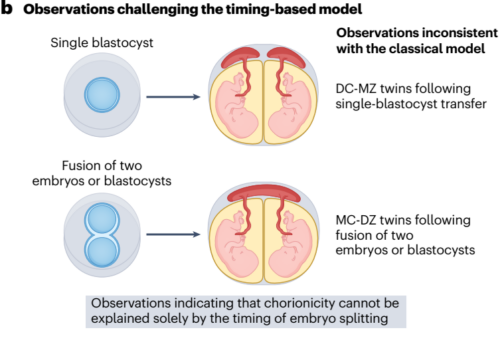
For example, following the transfer of a single day-4 or day-5 embryo, one would traditionally expect any subsequent division to result in monochorionic monozygotic twins sharing a single placenta. However, this is not invariably observed, as dichorionic twin pregnancies and even cases involving dizygotic twins have been reported following single-embryo transfer.
These findings indicate that placental configuration alone is insufficient to infer embryonic origin and suggest that multiple developmental pathways may lead to monozygotic twin formation, rather than twinning being determined exclusively by the timing of zygotic division.
Spontaneously conceived dichorionic diamniotic (DCDA) twin pregnancies account for approximately 1 in 100 pregnancies, whereas monochorionic diamniotic (MCDA) twin pregnancies represent approximately one-third of all twin pregnancies, corresponding to an overall incidence of approximately 1 in 300 pregnancies.
The incidence of MCDA pregnancies increases to approximately 1 in 50 following assisted reproduction (IVF) and to 1 in 25 following ovulation induction.
Finally, approximately 65% of spontaneously conceived monozygotic twin pregnancies are monochorionic, while the remaining 35% are dichorionic.
Following assisted reproductive treatment, the proportion of monochorionic pregnancies among monozygotic twins increases to approximately 80%. This suggests that approximately 1.5–2% of pregnancies following single-embryo transfer may result in monozygotic twinning, most frequently with monochorionic placentation.
Thus, whereas dizygotic twinning demonstrates a familial predisposition, monozygotic twinning is generally considered sporadic, with an increased incidence primarily associated with assisted reproductive technologies.