What is pre-eclampsia?
Pre-eclampsia is a multisystem disorder of pregnancy that develops after 20 weeks of gestation. It is characterized by new-onset arterial hypertension:
Systolic blood pressure ≥140 mmHg and/or diastolic blood pressure ≥90 mmHg, based on the average of two measurements,
associated with one or more of the following:
Therefore, proteinuria is not mandatory for the diagnosis of pre-eclampsia when new-onset hypertension is accompanied by maternal organ or uteroplacental dysfunction.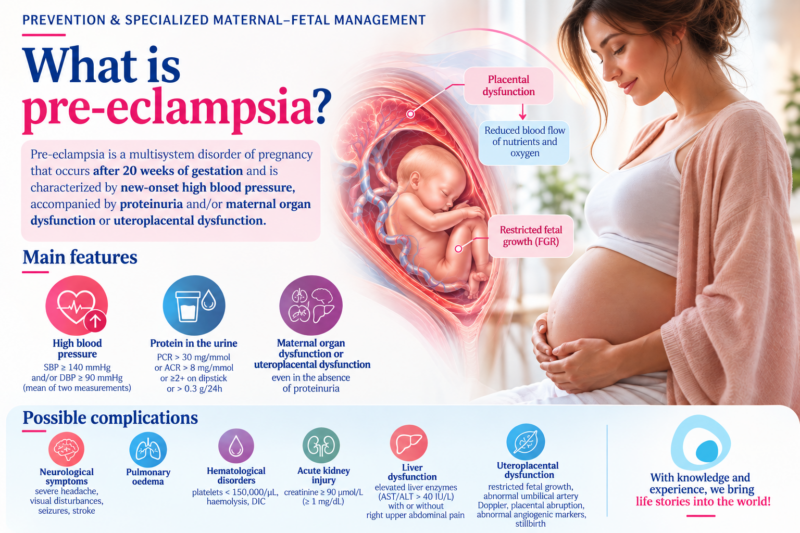
The exact cause of pre-eclampsia is not fully understood. There are often no symptoms, and the condition may first be detected during a routine antenatal appointment when blood pressure is measured and urine is tested. This is why regular antenatal blood pressure monitoring and appropriate laboratory assessment are so important.
Chronic hypertension: hypertension that predates pregnancy or is diagnosed before 20 weeks. It may be primary, with no identifiable underlying cause, or secondary, for example due to renal disease.
White-coat hypertension: office blood pressure ≥140/90 mmHg, while home blood pressure is <135/85 mmHg.
Masked hypertension: office blood pressure <140/90 mmHg, while home blood pressure is ≥135/85 mmHg.
Gestational hypertension: new-onset hypertension after 20 weeks without proteinuria or other features of pre-eclampsia.
Transient gestational hypertension: new-onset hypertension that subsequently resolves on repeated measurements.
Pre-eclampsia: new-onset hypertension accompanied by proteinuria and/or maternal organ dysfunction and/or uteroplacental dysfunction. Manifestations may include neurological abnormalities, pulmonary oedema, hematological, renal or hepatic abnormalities, fetal growth restriction, abnormal Doppler findings or angiogenic imbalance.
Pre-eclampsia superimposed on chronic hypertension: development of maternal organ or uteroplacental dysfunction consistent with pre-eclampsia in a woman with chronic hypertension; new-onset proteinuria may also occur but is not, by itself, the only criterion.
Approximately 40% of women with transient gestational hypertension may subsequently develop gestational hypertension, while women who develop gestational hypertension early in pregnancy are at increased risk of progressing to pre-eclampsia.
For this reason, women with gestational hypertension require close surveillance for signs and symptoms of pre-eclampsia, laboratory abnormalities and fetal/placental dysfunction. Follow-up may include assessment of proteinuria when clinically indicated, serial fetal growth and amniotic-fluid assessment, Doppler studies and, in selected women, angiogenic markers such as PlGF and the sFlt-1/PlGF ratio.
Why do I need to know if I have pre-eclampsia?
Pre-eclampsia is a relatively common pregnancy complication, affecting approximately 2–8 in every 100 pregnancies worldwide.
Although many cases are mild, pre-eclampsia can occasionally progress rapidly and become a serious, potentially life-threatening condition for both the mother and the baby.
Severe manifestations may include persistent severe headache that does not respond to simple analgesics, eclamptic seizures, altered consciousness or stroke; visual disturbances such as blurred vision or scotomata; pulmonary oedema; thrombocytopenia, haemolysis or disseminated intravascular coagulation; acute kidney injury; elevated liver enzymes with or without right upper abdominal or epigastric pain; and uteroplacental dysfunction, including placental abruption, abnormal angiogenic markers, fetal growth restriction, abnormal umbilical artery Doppler findings and intrauterine fetal death.
These symptoms and findings are serious and require immediate medical assessment. If there is any concern, the pregnant woman should contact her obstetrician or maternity unit without delay.
How may pre-eclampsia affect my baby?
Pre-eclampsia is closely associated with abnormal placental development and function. Placental dysfunction can reduce the delivery of oxygen and nutrients to the fetus and consequently interfere with normal fetal growth, resulting in fetal growth restriction (FGR).
There may also be a reduction in the amount of amniotic fluid surrounding the baby (oligohydramnios).
When placental dysfunction is severe, fetal wellbeing may be significantly compromised and, in the most severe cases, intrauterine fetal death may occur.
The purpose of close maternal and fetal surveillance is to identify fetuses at increased risk and determine the safest possible time for delivery, balancing the risks of continuing the pregnancy against those associated with prematurity.
Angiogenic markers provide important information regarding placental dysfunction and the risk of pre-eclampsia.
Placental growth factor (PlGF) forms part of first-trimester multiparametric screening for pre-eclampsia, together with maternal characteristics, blood pressure and uterine artery Doppler assessment. This allows identification of women at increased risk of developing preterm pre-eclampsia and enables preventive treatment with aspirin to be offered.
Later in pregnancy, PlGF and/or the sFlt-1/PlGF ratio may be useful in women with suspected pre-eclampsia, gestational hypertension or symptoms suggestive of the disease.
These biomarkers can be particularly useful in difficult diagnostic situations, including women with pre-existing proteinuria, chronic hypertension or chronic kidney disease, in whom conventional diagnostic criteria may be more difficult to interpret.
Angiogenic markers should always be interpreted in conjunction with the clinical picture, blood pressure, laboratory investigations and fetal assessment rather than being used as isolated diagnostic tests.
Pre-eclampsia can occur in any pregnancy, but the risk is increased in women who have chronic hypertension, previous gestational hypertension or pre-eclampsia, chronic kidney disease, diabetes mellitus, systemic lupus erythematosus, antiphospholipid syndrome or obesity.
Other factors associated with increased risk include a first pregnancy, maternal age ≥40 years, previous placental abruption, fetal growth restriction or intrauterine fetal death, high maternal BMI, a family history of pre-eclampsia in the mother or sister, and multiple pregnancy.
However, clinical risk factors alone do not identify all women who will subsequently develop preterm pre-eclampsia.
For this reason, where available, first-trimester multiparametric screening, such as the FMF algorithm used in our practice, provides a more individualized assessment of risk. It combines maternal characteristics and medical history with biophysical and biochemical markers.
Women identified as being at increased risk of preterm pre-eclampsia are offered aspirin 160 mg once daily, preferably started during the first trimester and continued until 36 weeks of gestation, according to the preventive protocol used in our practice.
Prevention also includes regular physical activity during pregnancy, unless contraindicated.
In women with low dietary calcium intake, particularly when calcium intake is below approximately 900 mg/day, calcium supplementation should be considered according to individual dietary intake and clinical circumstances.
Once pre-eclampsia has been diagnosed, closer maternal and fetal surveillance is required.
Maternal monitoring includes frequent blood-pressure measurements and assessment for symptoms or signs of disease progression. Blood tests include platelet count, renal function and liver enzymes. In established pre-eclampsia, repeated quantification of proteinuria is generally not useful for determining disease severity once the diagnosis has been established.
Depending on the severity of the condition, laboratory and clinical assessment may be required approximately twice weekly or more frequently.
Fetal surveillance includes assessment of fetal heart rate when indicated and serial ultrasound examinations for fetal growth, amniotic-fluid volume and Doppler velocimetry. The frequency of ultrasound monitoring is individualized according to gestational age, fetal growth and Doppler findings, and the maternal clinical condition.
Hospital admission may be required, particularly in women with severe hypertension, progressive maternal organ dysfunction, concerning symptoms or evidence of fetal compromise.
Pre-eclampsia and severe gestational hypertension can deteriorate rapidly. Hospital assessment and, in many cases, admission are therefore required.
Selected women with stable disease, blood pressure below the severe range and no maternal or fetal complications may be managed as outpatients, provided that close and reliable maternal and fetal surveillance can be ensured.
The objective of antihypertensive treatment is to reduce the maternal risk associated with severe hypertension while maintaining adequate uteroplacental perfusion.
A practical therapeutic target is a systolic blood pressure of approximately 110–140 mmHg and a diastolic blood pressure around 85 mmHg.
If blood pressure becomes excessively low, particularly if diastolic pressure falls below approximately 80 mmHg or the woman develops symptoms of hypotension, treatment should be reassessed and may need to be reduced.
Moderate hypertension can generally be treated with oral medication. Commonly used drugs include labetalol, nifedipine and methyldopa, depending on the individual patient and clinical circumstances.
Severe hypertension (≥160/110 mmHg) requires urgent treatment. Oral immediate-release nifedipine or intravenous labetalol or hydralazine may be used according to the clinical situation and local protocol.
Antihypertensive treatment is continued during labour when required, with close blood-pressure monitoring.
Women with eclampsia should receive intravenous magnesium sulfate to prevent recurrent seizures.
Magnesium sulfate is also recommended for seizure prophylaxis in women with pre-eclampsia with severe features, particularly when severe hypertension is accompanied by neurological symptoms or when there is a high risk of eclampsia.
Magnesium sulfate substantially reduces the risk of eclamptic seizures and their recurrence.
Delivery is the only definitive treatment for pre-eclampsia, although the optimal timing depends on gestational age and the condition of both mother and fetus.
Regardless of gestational age, earlier delivery may become necessary when maternal or fetal deterioration makes continuation of the pregnancy unsafe. Important indications include eclampsia or progressive neurological symptoms; persistent severe headache or recurrent visual scotomata; severe hypertension that cannot be adequately controlled despite appropriate antihypertensive treatment; pulmonary oedema; severe or progressive thrombocytopenia; haemolysis or clinically significant coagulopathy; progressive renal or hepatic dysfunction; hepatic complications; placental abruption; or evidence of significant fetal compromise.
In extremely early severe pre-eclampsia before the limits of neonatal viability, maternal risks and the extremely poor fetal prognosis must be carefully discussed. Management is individualized in a tertiary maternal–fetal medicine centre, and termination of pregnancy may need to be considered when continuation poses an unacceptable maternal risk.
When maternal and fetal conditions remain stable and there is no indication for immediate delivery, expectant management in an appropriate tertiary centre may be considered.
The objective is to prolong pregnancy safely and reduce complications associated with extreme prematurity while ensuring that delivery is undertaken promptly if maternal or fetal deterioration occurs.
The decision regarding delivery should be individualized according to maternal and fetal status, disease severity and neonatal considerations. Delivery may reduce maternal complications, while continuation of pregnancy may reduce complications associated with late prematurity.
For women with pre-eclampsia, delivery should generally be planned from 37 weeks of gestation.
In women with gestational or chronic hypertension without pre-eclampsia, the timing of delivery is individualized according to blood-pressure control, maternal and fetal condition and obstetric factors.
Antenatal corticosteroids are recommended when preterm birth is considered likely within the following 7 days, particularly before 34 weeks of gestation.
Their administration reduces neonatal respiratory morbidity and other complications associated with prematurity, including respiratory distress syndrome and intraventricular haemorrhage, and improves neonatal outcomes.
A single course of antenatal corticosteroids is generally given. In selected women who remain at significant risk of preterm birth, a repeat course may be considered according to gestational age, the interval since the initial course and the applicable clinical guideline.
Between 34+0 and 36+6 weeks, corticosteroids may be considered in selected women at high risk of delivery within 7 days who have not previously received antenatal corticosteroids, after individualized assessment.
At present, delivery remains the only definitive treatment for pre-eclampsia.
Several therapeutic approaches have been investigated in an attempt to modify the underlying pathophysiology of the disease, particularly the angiogenic imbalance, endothelial dysfunction and inflammatory response associated with pre-eclampsia.
Agents including statins, metformin and various targeted biological or antibody-based therapies have been or are being investigated. Their principal objective is to delay disease progression and safely prolong pregnancy.
At present, however, these approaches remain investigational and have not replaced established preventive, surveillance and delivery strategies.
A previous history of pre-eclampsia increases the risk of recurrence, although the magnitude of the risk depends strongly on the gestational age at which the previous disease developed, its severity and the presence of associated maternal or fetal complications.
Overall, approximately one in six women with previous pre-eclampsia may develop the condition again in a subsequent pregnancy.
The recurrence risk is substantially higher after very early or severe disease. Women whose previous pregnancy required very preterm delivery because of severe pre-eclampsia represent a particularly high-risk group.
Women with previous gestational hypertension also have an increased risk of both gestational hypertension and pre-eclampsia in a subsequent pregnancy.
In addition, women with a history of hypertensive disorders of pregnancy have an increased risk of having a small-for-gestational-age (SGA) fetus, even when blood pressure remains normal in the subsequent pregnancy.
The presence of additional risk factors, very early previous pre-eclampsia, recurrent disease or previous maternal/fetal complications can increase the recurrence risk substantially, in some high-risk groups approaching 50%.
For this reason, preconception counselling and first-trimester pre-eclampsia screening are particularly important in subsequent pregnancies.
High-quality medical services from Obstetrician-Gynecologist Alexandros Mainas, in Komotini.